Preserving and uplifting Black histories in Westchester County through public art, education, and community engagement.
“What policy razed, policy must raise.”
Commemorate is a volunteer group (founded in 2018) that digs into and shares Irvington’s overlooked history of slavery, then turns that research into real community impact.
We’ve led major public programs, especially around Juneteenth, including events and conversations at the Irvington Theater and the library that bring history to life in an accessible, engaging way.
A big recent highlight is our documentary, The Hidden Cost of Progress: Urban Renewal in Ossining, which centers Black community voices and examines the lasting harm of urban renewal policies. It’s a powerful extension of our work beyond Irvington.
Along the way, we’ve also helped reshape local storytelling—supporting public art like Yesterday on Main Street, contributing research that influenced policy changes, and working with schools to teach a fuller, more honest history.
Overall, we connect past to present—through research, storytelling, and community events that actually bring people together.
Commemorate by the numbers….
-
Commemorate is founded
-
Enslaved Africans identified by name
-
Enslaved in Westchester, 1771
-
Major Commemorate Initiatives
“Yesterday”
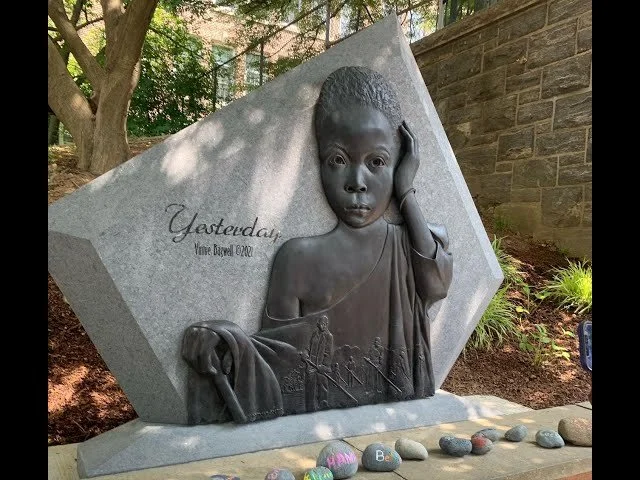
a sculpture by Vinnie Bagwell, honoring the memory of the Enslaved.
Unveiled on June 10, 2023, "Yesterday" is a bronze bas-relief sculpture by renowned Yonkers-based artist Vinnie Bagwell. The work depicts a pensive young African girl, approximately six years old, resting her chin on her hand in contemplation. Rising from her garment is an image of enslaved Africans toiling at agricultural work — a haunting reminder of the labor that built Westchester's wealth.
The sculpture is cast in bronze upon a marble base, affixed to a beveled black granite slab. It stands on Main Street in Irvington, between Village Hall and Main Street School, near the newly named Madam C.J. Walker Plaza. The title evokes the truth that while slavery ended nearly 200 years ago, its legacies persist and are as close as yesterday.
"In 1790, one out of every two households in Irvington enslaved people. Some founding families enslaved four to ten people."
Historical Context
In 1723, Westchester County's enslaved population was 448. By 1771, that number had surged to 3,430 — outnumbering the enslaved population of Manhattan. The founding families of Irvington — Odell, Dutcher, Dearman, Acker, Buckhout — all enslaved people, yet their names were preserved in streets and landmarks while those they enslaved were forgotten.
Through four years of meticulous research into estate inventories, court records, and wills, Commemorate co-founders Sarah Cox and Cathy Sears identified the names of 14 enslaved Africans who lived in colonial Irvington. The publication "Our Town and Slavery" in The Roost (Irvington Historical Society, 2019) brought these names back into public memory for the first time.
The Hidden Cost of Progress: Urban Renewal in Ossining
a documentary revealing how policy displaced Black families and businesses
The Hidden Cost of Progress — Urban Renewal in Ossining" is a powerful and deeply personal documentary produced by Joyce Sharrock Cole and Ken Sargeant. The film reveals how urban renewal policies in the 1970s devastated the Black community of Ossining, New York.
The south side of Main Street was demolished under an "urban renewal" effort that was intended to combat blight but instead destroyed a thriving Black neighborhood. Route 9 was widened, slicing the village in half. Buildings were razed, businesses shuttered, and families displaced. The lots remained vacant for decades, ultimately becoming surface parking lots — a stark monument to what was lost.
Members of Ossining's Black community have long called the urban renewal project "negro removal" — a term that captures the devastating reality of what happened. Generational legacies were erased under the guise of development, and the community still grapples with the consequences today.
The documentary has been screened at the Ossining Public Library, Irvington Library, and community venues across Westchester County, sparking vital conversations about the intersection of policy, race, and place.
engage with our work
reach out
Complete the form to initiate a dialogue about collaborative opportunities, tailored workshops, or media inquiries.